Case study
Thread: A Quiet Puzzle iOS app
A self-directed project taken all the way from prototype to a shipped App Store release: an original puzzle game designed around calm.
The idea
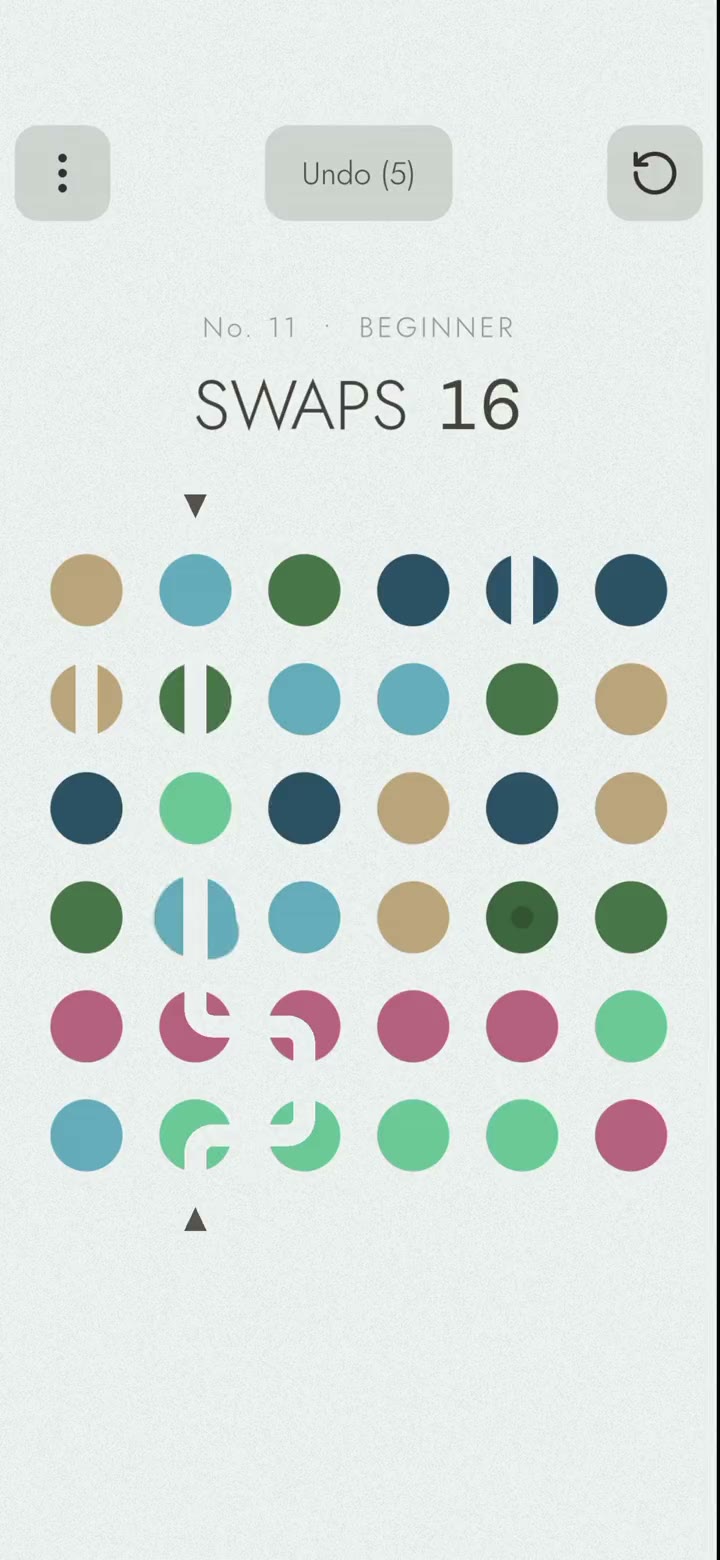
Thread is a logic puzzle built around two problems solved at the same time: sort colored dots into matching rows, and rotate pipe segments to connect a path through the board. When both line up, you trace the thread from one end to the other and the puzzle resolves.
The design constraint I set was about tone rather than mechanics. Nearly every free mobile puzzle game is engineered to pull at you — timers, streaks, lives, interstitial ads, push notifications engineered around the fear of losing progress. I wanted to build a game where players could enter a calm and meditative flow state.
A quiet puzzle for the overstimulated mind. No ads, no timers, no pressure.
Designing the rules
The core loop had to be legible in a few seconds and still have depth several hours in. Rather than hand-authoring levels, every puzzle is procedurally generated and guaranteed solvable, so the game never runs out and never presents a dead end.
Difficulty comes from layering constraints onto the same board rather than from speed:
- Anchored dots that can’t be moved at all
- Weighted dots that only inch forward one step at a time
- A swap limit that tightens as tiers progress, so efficiency starts to matter more than persistence
I built an early demo in the game engine Godot and tested the first iteration with my family and friends. One of the design constraints I set was that my five-year-old son had to be able to play it himself — if he could do it and have fun, I figured I was moving in the right direction.
The payoff had to be felt, not scored. With no points, no timer, and no streak to protect, the reward for solving a board is the resolution itself — the thread drawing through, the haptics building as it traces, the sound landing. That moment carried the whole reward structure, so it got a disproportionate share of the polish time.
It took dozens of iterations and test builds to get the feeling right on my phone. I tested different “thread” styles, haptic strengths, and particle flourishes before I settled on the final direction.
Designing for calm
It was important to me that the visual system stay as simple and minimalist as possible. Rather than draw inspiration from other games, I looked to meditation and journaling apps. I created seven color palettes inspired by my home in the Pacific Northwest.
A few other notable features:
- Haptics tuned to build as the final thread traces
- Badges and stats that report how you play without ranking you against anyone
- Daily Thread — a new puzzle every day, with sharing options. The only slightly competitive thing about the gameplay, if you choose to share with friends.
Soundtrack and sound design
A game built on calm lives or dies on how it sounds. Rather than license a stock ambient bed, I wrote, performed, and recorded the entire soundtrack and sound design myself.
Soundtrack
I compose music, play in a steel drum band, and have contributed to soundtracks for games including Ithya: Magic Studies, so I knew from the beginning that I wanted to record my own soundtrack.
Between stretches of writing code and testing, I recorded six original ambient tracks that loop quietly in the background while you play.
Sound design
I had so much fun recording the sound effects for this game, and it turned out to be a family project.
- When two dots swap, the sound comes from a magnet toy my son has — he helped record the sample.
- When a dot is selected, the game plays a kalimba that I sampled from my own collection of instruments. In Godot, I wrote code to pitch that sound effect up and down at random, so it stays interesting instead of grating over a long session.
- All of the sound and music in the game sits in the C minor pentatonic scale, which, if you’re not a music theory person, means that everything layers well together.
Beta testing with TestFlight
I ran the game through a beta group of 40 testers in Apple’s TestFlight before submitting to the App Store.
- Testers were recruited from a variety of places: Bluesky, Reddit, and YouTube.
- Feedback came in through online comments and TestFlight’s built-in reporting.
- The top thing that came back was confusion in the first few minutes, so I built a brand-new onboarding flow to teach the rules to first-time players.
This is legitimately relaxing. I’ve been playing on the train after work.
Shipping it
Thread launched on the iOS App Store on August 7, 2026.
The business model was held to the same standard as the rest of the design: the first two tiers are free, and a single purchase unlocks all current and future content. No subscription, no consumables, no ads, and the app collects no data from players at all.
Post-launch roadmap
I’m continuing to add to Thread after launch. The immediate plan for the coming months:
- Accessibility options for color-blind players
- Seasonal color palettes
- A relaxing rain ambience mode